

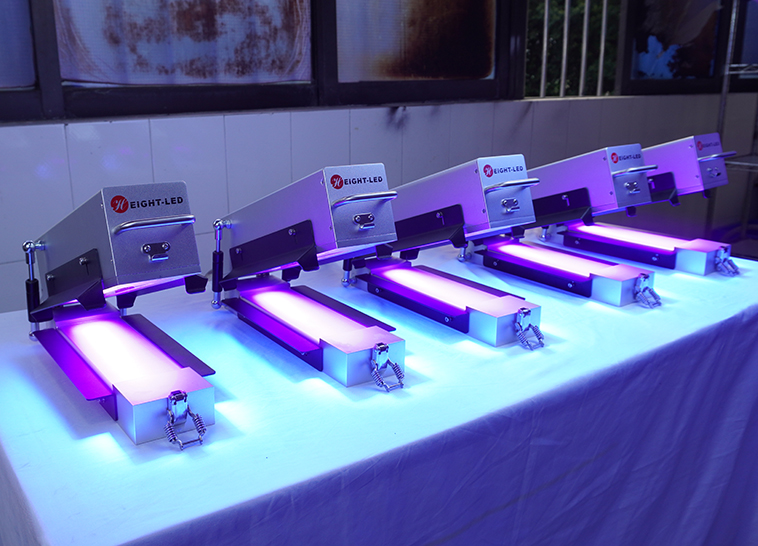
Why do most uvled surface light sources need to be configured with a water-cooled machine equipment? uvled curing machine at work, the machine will release a lot of heat during operation, the accumulation of machine temperature will become high, will have a certain impact on some heat-sensitive materials, especially some industries that need to use high power, their energy requirements are relatively high, such as UV ink, UV glue, film materials, etc., at which point we need to configure a water-cooled machine for the face light source equipment for effective heat dissipation.
What is the difference between air cooling and water cooling?
The air-cooled cooling device is relatively simple, it is through the uv led surface light source irradiation head back of the fan for heat dissipation, the temperature can generally be controlled between 50-70 degrees.
And water-cooled cooling is equipped with a relatively independent water-cooled machine, the use of water-cooled machine internal water circulation to achieve the effect of cooling, the principle is the UVLED curing lamp body inside the water, after running the heat to a certain extent, and then by the heat control system to reach a certain temperature after the temperature control, the water will flow back to the configuration of the cooling equipment inside, cooling equipment and then cool the hot water back to the UVLED curing lamp. The general temperature of the water cooler can be controlled at about 35 degrees, which can be used for products with high temperature or heat sensitive and easily deformed, such as printing and drying, paper, gold and silver cardboard, film, PVC, electronic device gluing, etc.

